Side Projects
Experiments, prototypes and explorations at the intersection of Web3, decentralised systems and real-world delivery.
View all repositories on GitHubMSc Dissertation Showcase
A Hybrid Zero-Knowledge Architecture for Healthcare Data Access
Supervised by Professor Sean Keys, Atlantic Technological University, Letterkenny, Ireland.
Most blockchain healthcare systems pick a side. Either every piece of data gets the same heavyweight zero-knowledge cryptographic treatment, which is expensive and slow, or routine role-based access controls everything, which is fast but offers no privacy protection for sensitive records. My dissertation asked a different question: what if the system routed each request based on how sensitive the data actually was.
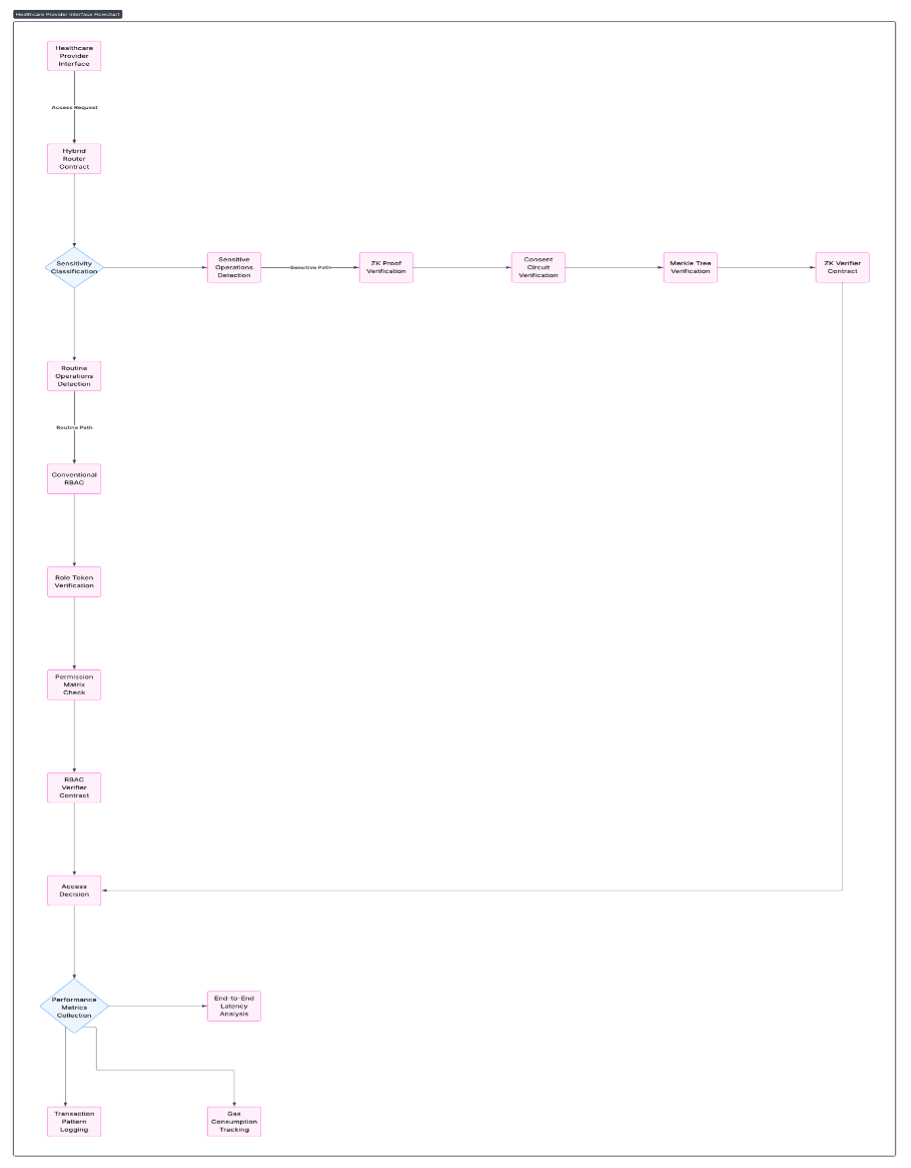
The architecture sorts access requests into two paths. Routine clinical data, vital signs, medications, lab results, runs through lightweight role-based access control. Sensitive categories under HIPAA, mental health records, substance abuse history, genetic testing, route through a zero-knowledge proof circuit that verifies consent without revealing the underlying request details on-chain.
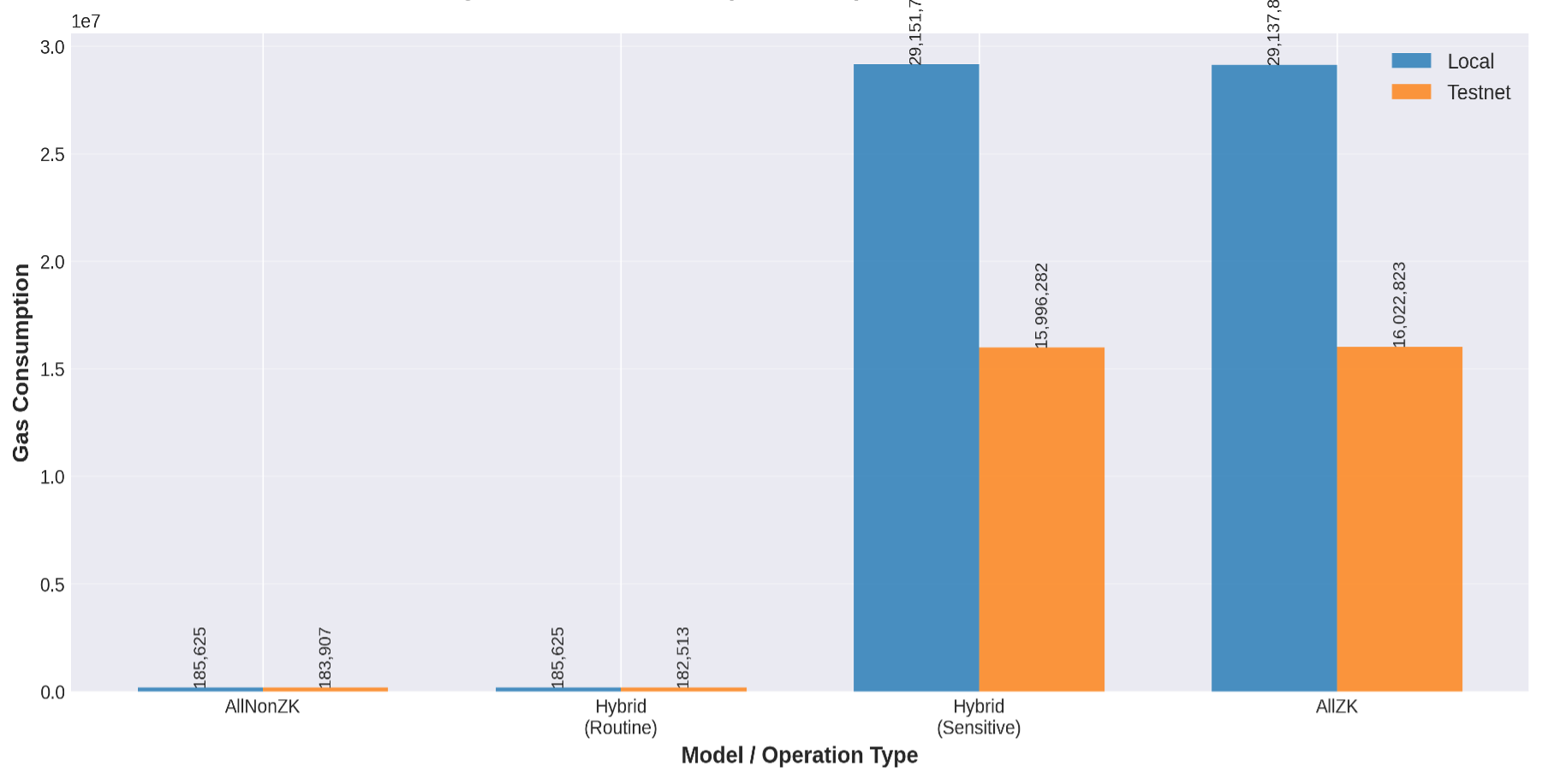
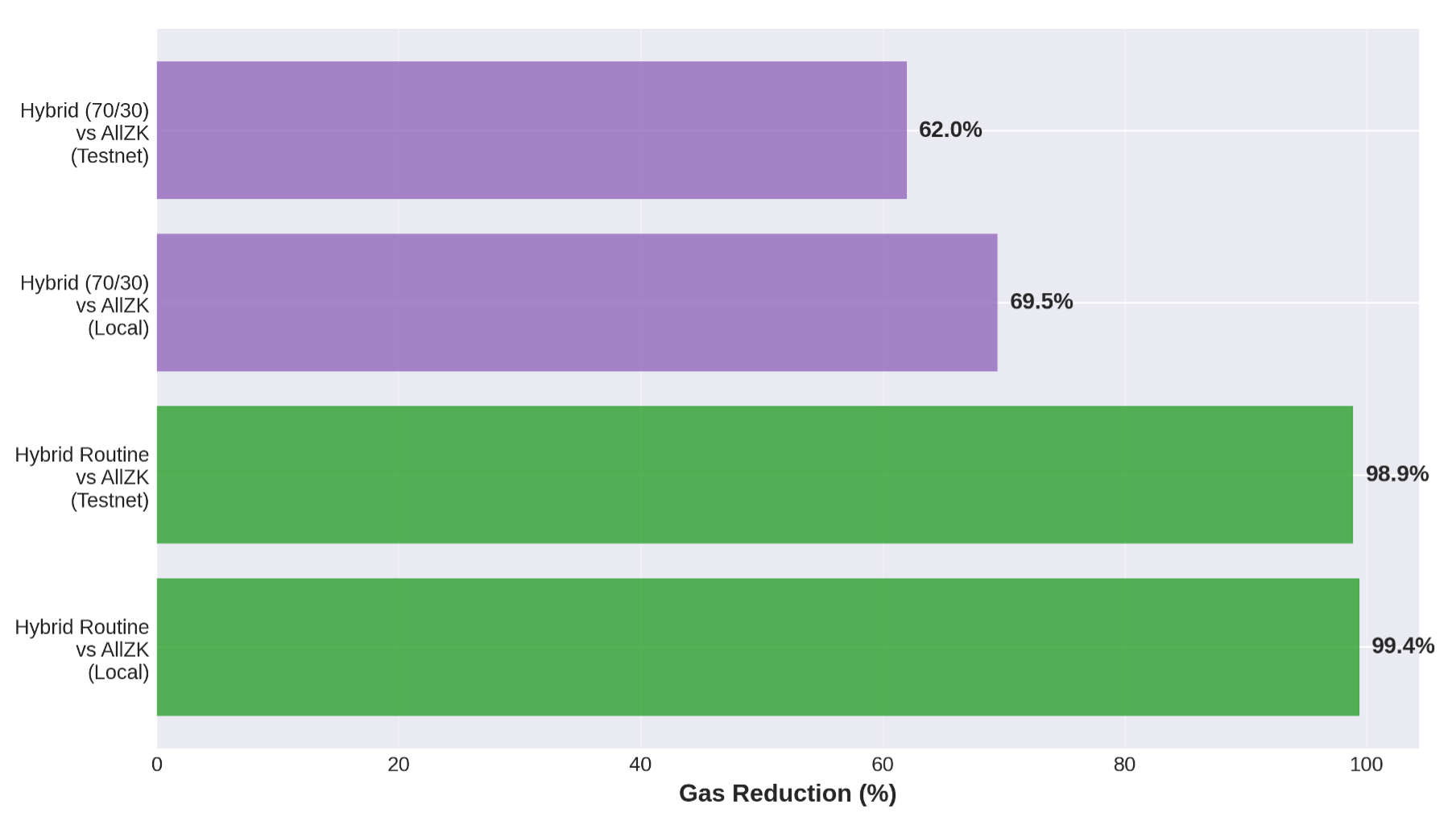
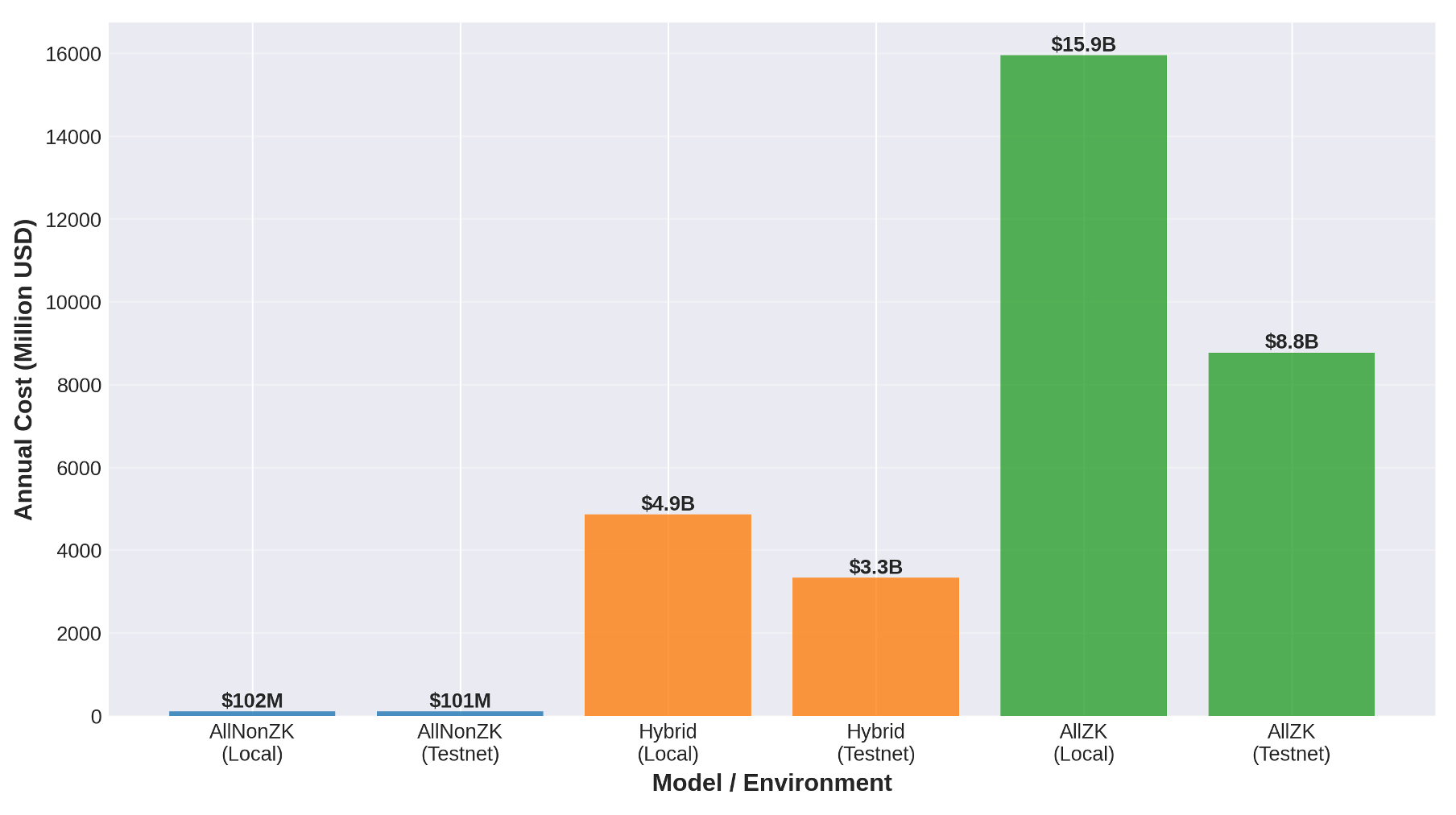
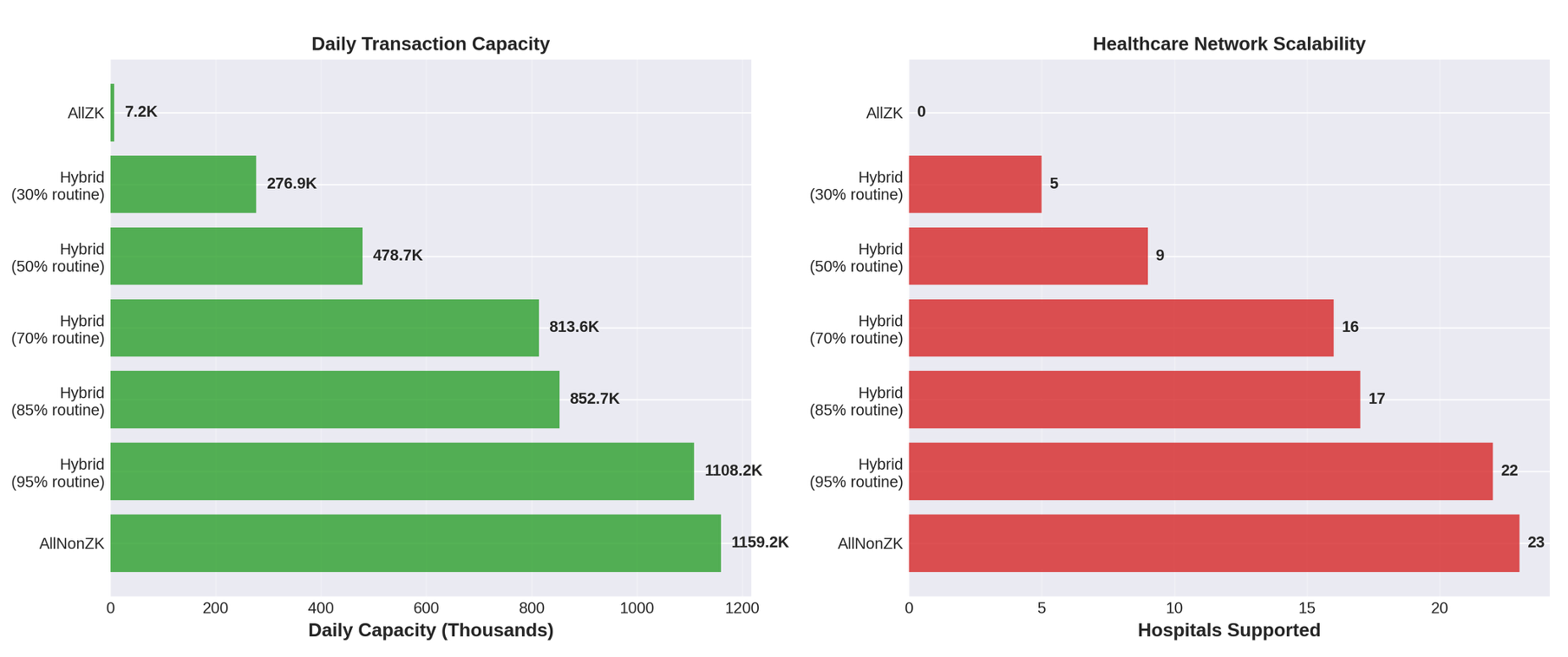
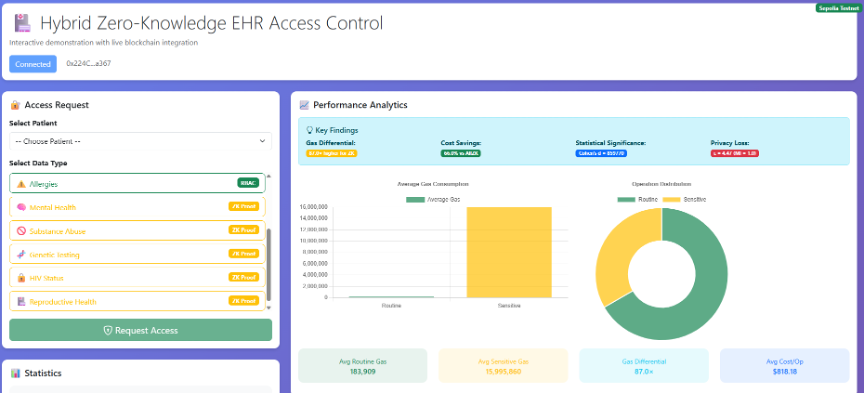
I built and deployed three competing models on the Ethereum Sepolia testnet to test this properly: an all role-based baseline, an all zero-knowledge maximum privacy version, and the hybrid model I proposed. Across more than a thousand real testnet transactions, the hybrid approach cut gas costs by 49 to 69 percent compared to the all zero-knowledge model, while still giving sensitive data the cryptographic protection it needs.
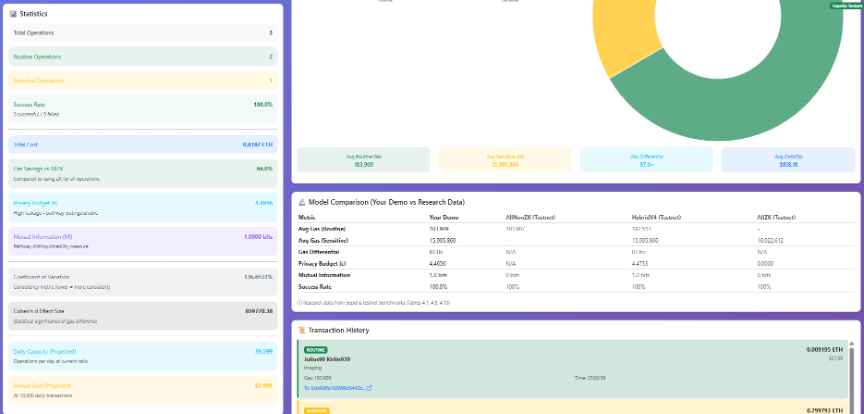
The honest finding, the one I am proudest of including, is that the hybrid approach is not free of trade-offs. Routing by sensitivity means an observer watching gas consumption patterns can tell which path a request took, even without seeing the data itself. I measured that leakage directly, a privacy budget of 4.4733 and a perfect statistical correlation between gas cost and pathway. Most papers in this space report their wins. I wanted to report the cost of mine too.
The result is a fully working system, three deployed smart contracts, working zero-knowledge circuits and an interactive demo connected to live testnet contracts, not just a theoretical model on paper.
Paper publication coming soon.

ETHDublin Hackathon
JusticeChain, Decentralised Case Tracking for the Courts
The idea for this project did not start in a hackathon room. It started months earlier, sitting in a courthouse waiting room, being told that my custody paperwork had gone missing somewhere between departments. No one could tell me where it was, who had touched it last, or when it might turn up. There was no tracking number, no audit trail, nothing to check except calling back and waiting.
That experience stayed with me, and when ETHDublin came around, I had a clear answer to the question every hackathon team has to ask: what problem are we actually solving. Court case management is still largely paper-based or siloed in systems that do not talk to each other, which means a single missing file can stall someone's life with no visibility into why.
JusticeChain, built on Solidity in 24 hours with my team, puts the chain of custody for a case on-chain instead. Every stage a case file moves through, filing, review, transfer between departments, decision, gets recorded as an immutable, timestamped entry that any authorised party can check. Nothing can quietly disappear between two desks anymore, because every handoff leaves a permanent, verifiable record.
It is a hackathon build, not a production court system, and there is a long road between a 24 hour prototype and something a real justice system could adopt. But the core idea held up under judging, and more importantly to me, it solved the actual problem I had personally lived through months earlier.
Blockchain Masters Project
A Borderless Loyalty Token, Built as a Blockchain Masters Project
Who doesn't like rewards. Every retailer has one, a card, an app, a points balance that resets if you don't use it fast enough, that only works at one store, in one country, under terms that change without much warning. As a mini project for my blockchain masters, I asked a simple question: what if your shopping rewards worked more like money, with no merchant lock-in and no border restriction at all.
I built SHOP, an ERC-20 token deployed on the Ethereum Sepolia testnet, around that idea. Customers earn SHOP automatically when a purchase is processed by any authorised merchant, with the reward amount tied directly to what they spent. From there the token behaves like a real asset rather than a points balance trapped in one app. Customers can stake it across three tiers, with multipliers from 1.1x up to 2.0x for larger stakes, to earn yield on top of what they already collected from shopping.
The part I found most interesting to design was the merchant side. Rather than every business needing its own loyalty infrastructure, any merchant can be authorised onto the same token system through a shared registry and a purchase validator contract. One token, many merchants, no border between them, and no need for a customer to juggle five different loyalty apps to get value out of five different stores.
It is a working prototype with live contracts and a connected front end, not just a whitepaper concept, built specifically to explore how a real consumer use case like loyalty rewards translates into smart contract design.
Web3 Community
Community Involvement With Solana Superteam Ireland and Campfire
Some of the most useful learning in web3 doesn't come from a repo, it comes from showing up consistently in a room full of people building in public. I've been a regular at Solana Superteam Ireland's weekly Friday meetups, the kind of recurring, unglamorous attendance that quietly builds real fluency in how a fast moving ecosystem actually works, project by project, week by week.
That involvement led to a hands-on contribution with Campfire, an on-chain renewable energy investing platform that tokenizes wind, solar, hydro and forestry projects so investors can earn yield and trade exposure to green energy directly. During their initial launch phase, I helped interview a candidate for a Rust developer role, evaluating technical fit for a stack that sits well outside my own day to day delivery background, which pushed me to genuinely understand what the role needed rather than rely on a generic checklist.
Beyond hiring, I joined sessions brainstorming Campfire's early business model and reviewing their Figma wireframes, contributing a delivery and user experience lens to a team that was still finding its shape. It is a small contribution next to building the product itself, but it is exactly the kind of early stage involvement that teaches you how an idea moves from a deck to something investors and users can actually trust.